Beginner guide
Everything is Crab Beginner Guide: First Win, Food, Evolutions and Survival Tips
Everything is Crab asks you to make a creature that can eat, move, avoid predators, defeat or outlast bosses, and keep adapting as the ecosystem gets meaner. This guide focuses on the first clear, not perfect theorycrafting.
Quick Answer
The safest beginner plan is to build around one consistent attack, one mobility or dodge tool, one food or sustain improvement, and one defensive layer. Do not pick every funny evolution just because it appears. Ask what job the run is missing: damage, food tempo, survivability, mobility, or boss control.
How the first ten minutes should feel
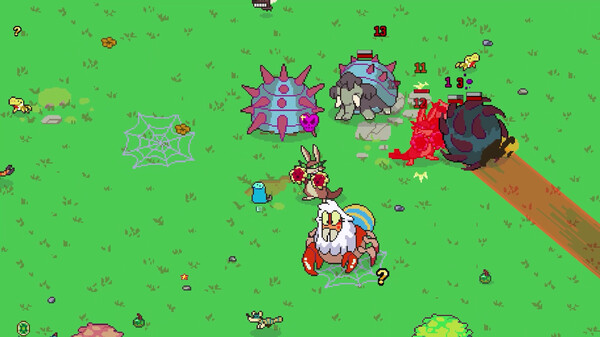
You begin as Darwin, a small vulnerable creature in a living ecosystem. The official description frames the loop as hunting, fleeing, scavenging, and thriving, and that is a useful mental model: fighting is only one tool. Beginners often die because they treat every nearby animal as a required duel.
Your early priority is simple: stay fed without getting trapped. Move in arcs around food, take easy resources, let dangerous creatures fight each other when possible, and level up before committing to risky boss damage. If your first evolution offer is not exciting, choose the one that makes your next two minutes safer.
Food, progress and leveling
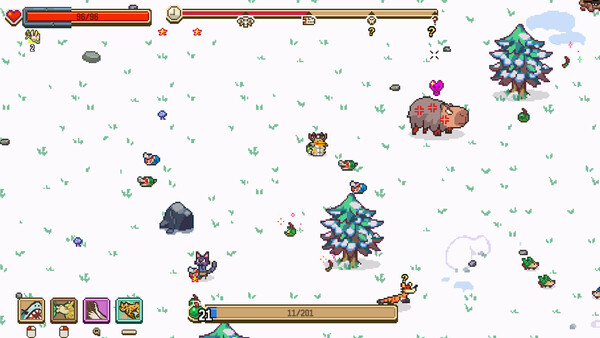
Community documentation separates food into fruit, fish, meat, mushrooms, and boss fruit. Basic food is eaten in bites, while boss fruit instantly completes the current level and grants a branching evolution choice. Golden and higher-rarity food matters because it speeds up level progress dramatically, especially later in a run.
| Food type | Beginner use | Risk note |
|---|---|---|
| Fruit | Clean early progress when you do not want to fight. | Do not camp a fruit patch if predators are circling it. |
| Fish | Good if the biome makes water access safe. | Water routes can become awkward without mobility. |
| Meat | Fast progress when other animals die near you. | Fresh meat is often surrounded by the thing that made it. |
| Mushrooms | Can help when identified and routed carefully. | Effects are assigned per run, so do not auto-pilot them. |
| Boss Fruit | Important after scheduled boss kills because it produces branching choices. | Some genetics and routes can change boss fruit value. |
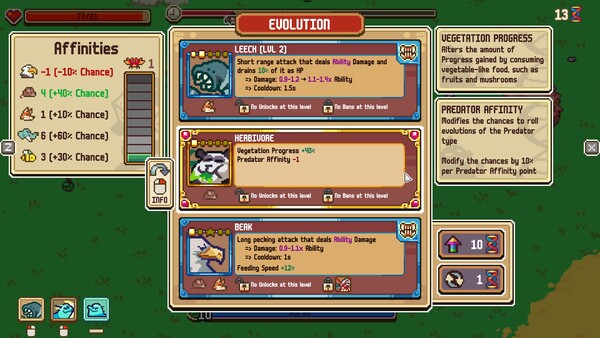
For first wins, treat food access as a build stat. Evolutions like Herbivore, Carnivore, Piscivore, Omnivore-style progress boosts, Ruminant, Nomadic, Forager, or feeding-distance improvements can be as important as raw damage because they generate more level choices.
How to choose early evolutions
Steam lists more than 125 evolutions and specialisations in the launch version. That variety is the hook, but it is also the trap. Your first several picks should answer concrete problems rather than build a novelty creature with no survival plan.
| Run problem | What to look for | Examples to research |
|---|---|---|
| You cannot reach food safely | Speed, dodge, feeding range, food progress | Smol, Sprint, Nomadic, Forager, Cheek Pouch |
| You lose boss fights slowly | Consistent attack plus armor or resistance answer | Beak, Horns, Claws, Pistol Pincer, Poisonous Saliva |
| You die to chip damage | Damage resistance, HP scaling, healing, size control | Shell, Plated, Robust, Subcutaneous Fat |
| You get overwhelmed | Charm, allies, control, area denial | Whining, Tail Wag, Toe Beans, Alpha, Pack |
| You need achievement setup | Named hooks for route goals | Stoner, Molting, Pincer, Scuttle, More Legs |
Use the evolution wiki if you want role notes, then test route fit in the build planner.
Boss basics for new players
Do not rush bosses just because their health bar exists. Watch a pattern, learn the safe side, then punish the end of an attack. The Crabtaur charge achievements teach this well: the game often rewards using boss behavior rather than simply face-tanking it.
For a first clear, bring one movement answer and one damage answer into scheduled boss fights. If a boss feels impossible, your problem may be speed, cooldown timing, arena clutter, or food tempo before the fight rather than the boss itself.
See the boss guide for Crabtaur, Clawdia, Shellephant, achievement hooks, and route notes.
Common beginner mistakes
- Picking three different attacks while leaving mobility and defense empty.
- Ignoring food tempo, then blaming the run because evolution offers stop scaling fast enough.
- Fighting every animal instead of scavenging from safer kills and dropped food.
- Using rerolls early without a reason. Rerolls have value, but panic rerolling wastes routing power.
- Chasing achievements like Zen, Dove, Bullseye, or Full House before you can reliably reach late game.
Sources and verification
This guide uses the official Steam store page, Steam Community announcements, the Steam achievements page, and community documentation such as Food on wiki.gg. Community route advice can change as patches and player testing continue.
FAQ
What is the best beginner build in Everything is Crab?
The best beginner build is usually not one exact list. It is a balanced shell: stable food progress, one reliable attack, one defensive tool, and one movement tool. Start with the starter build page if you want named route templates.
Should I fight or forage?
Forage when the map gives you safe fruit, mushrooms, fish, or dropped food. Fight when your current attacks can secure kills without losing more health than the food rewards can replace.
When should I start achievement hunting?
After you can reach late game consistently. Some achievements are natural progression, but no-hit, no-damage, and collection goals are much easier once you understand bosses and biomes.